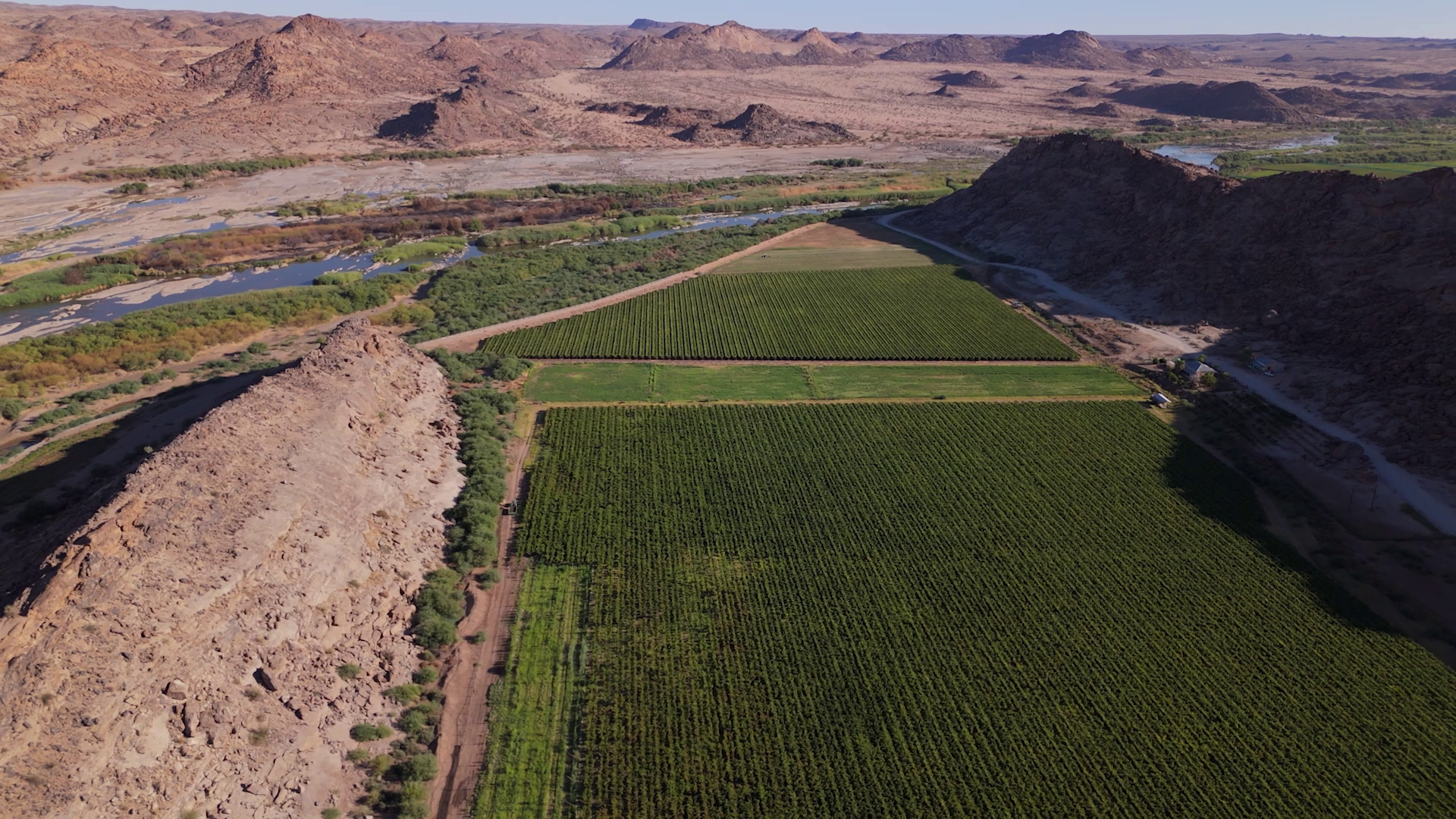
A Green Ribbon
Against a Dessert Backdrop
What began as a land restitution project in 2005 faced severe setbacks and was considered a failure by 2017. Today, however, it tells a very different story: one of resilience, revival, and shared success. Through the collective will of its 114 landowner beneficiaries, the daily dedication of over 300 permanent and seasonal workers, and the support of a wide network of partners, Elmboog has become a cornerstone of the Onseepkans community. Most households in the area now depend on the farm for their livelihoods, and its impact extends far beyond its vineyards.
Our Values
RESPECT
PRODUCTIVITY
COMMUNICATION

COOPERATION
RELIABILITY
What Makes Us Unique
We began as a land restitution initiative and have grown into a fully operational commercial farm, performing in the top third of the raisin industry.
Unlike most commercial farms that have one or two owners, Elmboog is owned by 114 individuals. This brings both complexity and cost, but also deep local ownership and shared purpose.
The land consists of separate plots, yet we operate as one unified farm under the business entity Elmboog Organiese Boerdery.
While most commercial farmers invest their own capital or take on debt, we developed our infrastructure with grant funding from government and development partners.
We carry a significant administrative burden to maintain our CC membership structure across 114 owners – far more demanding than traditional farm ownership models.
We are committed to employing only local labour from Onseepkans, despite the social and productivity challenges this sometimes presents.
Insights from the Journey
01. The pace of the farm is the pace of the people.
Progress only happens when the community is ready. Activities must be completed properly before the next step can begin. Rushing ahead leads to delays and frustration. Real progress is shared progress.03. Rural communities are capable – and determined.
They are resilient, resourceful, and fully able to master complex business principles. Given the chance, they don’t just participate – they lead.02. Community ownership makes funding harder – but also more rewarding.
Accessing commercial finance is particularly tough for community-owned enterprises. The risk is seen as higher, and the process requires persistence, patience, and trust-building. But when funding does come through, it uplifts more than just a business – it strengthens a whole community.04. Real change takes time – and staying power.
Consistent funding and ongoing developer engagement are essential for lasting impact. Trust and relationships aren’t a bonus – they’re the groundwork. Without them, nothing sticks. These lessons ground us. They remind us that growth is not just about outcomes, but about how we get there – and who comes with us.01. The pace of the farm is the pace of the people.
Progress only happens when the community is ready. Activities must be completed properly before the next step can begin. Rushing ahead leads to delays and frustration. Real progress is shared progress.
02. Community ownership makes funding harder – but also more rewarding.
Accessing commercial finance is particularly tough for community-owned enterprises. The risk is seen as higher, and the process requires persistence, patience, and trust-building. But when funding does come through, it uplifts more than just a business – it strengthens a whole community.
03. Rural communities are capable – and determined.
They are resilient, resourceful, and fully able to master complex business principles. Given the chance, they don’t just participate – they lead.04. Real change takes time – and staying power.
Consistent funding and ongoing developer engagement are essential for lasting impact. Trust and relationships aren’t a bonus – they’re the groundwork. Without them, nothing sticks. These lessons ground us. They remind us that growth is not just about outcomes, but about how we get there – and who comes with us.
Learn more about Elmboog Organiese Boerdery
Why is the farm called Elmboog?
The name Elmboog originates from a striking natural feature of the Orange River at Onseepkans. Close to the location of our farm, the river makes a dramatic elbow-like bend—known locally as an “elmboog.” This unique curve in the river not only gives the farm its name but also anchors it firmly to the land and community of Onseepkans. It is a name that reflects both place and identity, making Elmboog Organiese Boerdery inseparable from the landscape where it was born.
How was the name chosen?
The name Elmboog was chosen through a participatory process that involved both landowners and employees. Everyone was invited to nominate possible names, which were then discussed openly at the Annual General Meeting. In the end, Elmboog was selected by an overwhelming majority—almost unanimously—because it so perfectly reflects the identity and location of the farm.
Where does the name Onseepkans originate from?
The name Onseepkans traces its origins to the Nama language, with several possible roots offering glimpses into this place's deep connection to the land. According to linguistic sources, it may derive from a combination of three Nama words:
“tconsiep”, meaning an elbow-shaped projection into the river (yes, the one that inspired the Elmboog name!)
“nias”, referring to a rocky surface
“tcaans”, meaning thorn trees
Who owns the land?
19 pieces of land are owned by 114 beneficiaries, organised into 19 CCs. Each CC owns about 4 ha, and they have the title deeds. The operating company, Osk DevCo (Pty) Ltd, trading as Elmboog Organiese Boerdery and owned by the 114 landowners (The Beneficiary Trust), owns an additional 8 ha.
What are the structural and organisational arrangements?
The Beneficiary Trust comprises the 114 landowners. They elect Trustees at set intervals to represent them as Directors of the Board of the operating company, which they own 100%. Each of the CCs has a signed service-level agreement with the company, allowing the company to farm the land on their behalf. There is a rental agreement between each CC and the company, to pay rental income to the CC members annually after the harvest. The Board of Osk DevCo (Pty) Ltd has 6 directors – 3 Trustees, Business Manager, Blue Sky, and government. Blue Sky is secretariat.
Who do the assets belong to?
Each of the CCs, with their 6 members each, own the approximately 4 ha initially awarded to them in 2005. All additional land bought, as well as farming equipment and biological assets, belong to the company, which is collectively owned.
What benefits flow to the beneficiaries?
- Annual rental income, with a 5% increase year on year.
- About 20% of the beneficiaries also work on the farm, or their family members work on the farm.
- Some beneficiaries have supply agreements with the farm – e.g. to provide transport or catering.
- About R10 million per year goes back into the community through above channels.
Are there any other benefits or potential benefits for the beneficiaries?
Land value has increased significantly – both the land owned by the CCs and the land owned by Elmboog. In addition, when the business is fully sustainable and starts making a profit, there will be profit sharing, but currently all available money, apart from rent is used to buy additional land, equipment and to develop the vineyards. Training opportunities are also often extended to landowners.
Where does Elmboog source its labour from?
Unlike many other commercial farms in the region that bring in seasonal workers from elsewhere, Elmboog Organiese Boerdery is deeply rooted in Onseepkans itself. We are the only significant employer that draws almost all of our labour from the local community. While social challenges such as limited skills and issues like substance abuse do exist, we see it as our responsibility to create opportunities and invest in our people. Instead of looking outward, Elmboog works on building work-arounds and solutions—developing training, discipline, and support systems—so that the farm not only provides livelihoods but also contributes to the growth and resilience of the Onseepkans community.
What is the role of Blue Sky, the development partner in the business?
- We provide the scaffolding: Governance, administration, financial systems, and oversight.
- We are the glue holding 114 landowners, 19 CCs, funders, and management together.
- Without this facilitation, decision-making and compliance would stall, exposing the farm to potential collapse.
- Blue Sky does not have a day-to-day technical involvement in the business. We are developers, not farmers.
- Our role is to bridge the gap between the business manager and production managers by facilitating continuous skills transfer. Through education programmes with institutions such as Stellenbosch University and the Vine Academy, we ensure that technical expertise is embedded into Elmboog’s own team — building independence and reducing reliance on external support.
What is Blue Sky’s long-term plan?
Our mandate is temporary – to remove scaffolding responsibly when the business is ready. By then, Board secretariat, governance, and operational functions will be fully transferred to Elmboog. After exit, Elmboog may contract Blue Sky only for specialist support — but independence will be achieved.